Hear Ye! Since 1998.
27
Jan 10
Wed

Air New Zealand to Offer Beds in Economy

Air New Zealand will offer beds in economy class on their California to Auckland route. Now this is a game-changer. Adjoined sets of seats can be converted into small lie-flat beds. If you are travelling with someone else, you can purchase the third seat for half-price, which enables you to get a bed. (I wonder if you still have to buy a seat if the flight is not at full capacity?) But it does look like you need to be travelling with another, though. And it looks a little cramped if you don’t want to spoon.

Sorry Qantas, I’d be willing to connect through NZ if it meant I could get a good night’s sleep on the 12 hour trans-Pac flight – even though it adds a couple hours to the trip back to Sydney. (United can just go jump.)

  9:54pm  •  Travel  •  Tweet This  •  Add a comment  • 

  stuloh Hah, someone put up a picture of Moses holding two iPads on one of the network status monitors here.

  10:20am  •  Tweet  •  Tweet This  •  Add a comment  • 

Apple event – summary

Will compile a summary of the main points from the liveblogs, as it develops.

  • iPad
    • 9.7″ tablet, 0.5″ thick, 1.5 pounds (less then 700g)
    • multitouch,1GHz Apple A4 chip
    • 16-64 gigs flash storage
    • 802.11n, bluetooth 2.1 + edr
    • runs iPhone apps, but also has a separate set of iPad apps
    • speaker, microphone, accelerometer, compass
    • 10 hour battery life (playing videos)
    • Kinda sounds like a big iPhone
  10:02am  •  Consumer Electronics  •  Tweet This  •  Add a comment  • 
26
Jan 10
Tue

Money and Privacy talk (liveblogged)

Liveblogging for this post has now ended. Please start reading this post from the bottom.

06:21:05 pm: Audience question: concerned about add-ons to Firefox. [Reminds me about Chrome extensions – they disclose what information an extension will have access too, but one of the descriptors is “this extension will have access to all your private form data”. Which is kind of alarming because it sounds like the extension could sniff passwords out. If that’s not true, they need to rephrase it.] Ryan is plugging What App which is a service that rates app security. [I love the security paranoids who won’t use credit cards online in this day and age.] Ok, wrapping up now.

06:16:02 pm: Audience comment: internet searches on job applicants for screening purposes. Big issue for employer data collection.

Gin: In some ways, government regulation won’t be enough in the long run. Technology will need to fill in the gaps.

06:11:34 pm: Mozilla sometimes takes a minimal approach when it comes to data. If you don’t keep user data, a government can’t require you to deliver up what you don’t have.


06:06:52 pm: LinkedIn believes it needs to be very clear about what information it collects, and how readers can control their personal information. LinkedIn is very clear about monetization – describing what users get if they pay the subscription fee. Trust is key for their professional networking site. [Giving users the control helps a lot, apparently.]

06:02:05 pm: Gelman: user information is valuable. Is there a business strategy that leverages that? Sure, but it puts privacy on the line. [It’s a big balancing act. Depends on business model, whether it’s against your overall company mission, how will your customers feel? etc. Consent is a big thing… if users sign up to something knowing what they’re getting into, then less risk re violation of trust]

05:58:47 pm: Fourth issue: do you think there’s a tension between monetization [chasing revenue] and privacy? [This question reminds me of the Rapleaf story.] Gin: sure. His company could have gone down the route where consumer information was exploited. But he wanted a tool to help consumers, not the other way around.

05:54:52 pm: Should be an internal process to address UGC which violates that user’s local laws.

05:53:35 pm: Mozilla finds it very difficult to keep up with privacy regulations across the world. They want to crowdsource legal compliance similar to how they develop Firefox with an open source model.

Mozilla has several PPs broken down by product, not by countries. Firefox.de no really within German jurisdiction.

LinkedIn: “mission is to connect professional worldwide”. One PP, one TOU. By law, some provisions may or may not apply in different jurisdictions, so there are country-specific addenda to customize them. LinkedIn has a single “server” accessible worldwide. [single domain?]

Question from audience: rush to the bottom? Catering to the lowest common denominator? Isn’t that what happens if you only have one policy? How do you deal with different regimes?

Martin: It’s tough. It’s a big issue especially with user-generated content. [Now we’re getting into thorny jurisdictional issues in internet business.] Martin mentions differing free speech standards as an issue.

05:48:34 pm: Ryan draws analogy with Google in China – actions overseas can have a beneficial reputational effect back at home as well. Could also apply to privacy issues.

05:45:51 pm: Third issue: how do you deal with consumer expectations overseas? [They have different cultural views – eg, Europe is tougher.] Martin: Mozilla benefits from users around the world. Firefox has over 50% market share in Poland. Big share in Germany too. Users and governments there are more savvy about demanding more privacy protections there. Plays into the competitive issue – how it can be used for competitive advantage. Eg, they felt Firefox is more secure, so it gave Firefox an uptick in market share. German data protection authority issued statement that people need to be aware of certain ads – picking the right browser can help with this. People in Europe really care about this stuff, more so than US. Ryan: So you actually got a market share boost from a government statement on privacy! Martin: we had a 4-5% jump [!]

05:42:43 pm: Gelman mentioning Mint again – they are prime because they collect really juicy information (financial info across all your fin services providers). So from day 1, they need to get security and privacy right, even if they’re small, because they are a huge hacking target. [ie, Why do you rob banks? Because that’s where the money is. I guess start-ups like this need a lot of initial capital.]

05:39:37 pm: Ryan: What about Twitter? They were taken down last Thursday by an attack. Is there a point where you can get too big and not have enough? Gelman: Need to identify what data is at risk and adjust your investment in security accordingly. [Aren’t these points kind of obvious?] Ryan: If you’re a start-up, and you don’t have the resources to secure things… it’s tricky because you still need to do it. Like if you want to process credit card transactions. Rottenberg mentioning PayPal as an example. [the acoustics of this room are terrible, I’m missing comments…]

05:36:11 pm: Issue 2: relationship between size of company and security. Ryan asking Sitejabber – does the privacy policy disclose the security policies and risks?

Gin: of course, if you’re bigger, you’re a bigger target. In any event, you can’t guarantee 100% security.

Rottenberg: agrees. And that PPs should be written in plain English. LinkedIn making significant investment in IS security. As they’ve grown, they become a bigger target, so they have to scale security accordingly.

05:32:04 pm: Audience comment: what about teenagers? Can they understand privacy in a meaningful way? Doesn’t this affect how you can use privacy for competitive advantage?

05:30:02 pm: Rottenberg: FB just refreshed their privacy policy (default privacy setting to “everyone”). Lots of scrutiny. Martin: people only became aware due to the changes – without the change and surrounding publicity, no one would really notice.

LinkedIn uses a popup to notify of PP changes. As does FB. [So change events are particularly crucial.]

05:28:15 pm: LinkedIn currently reviewing privacy policy: “I can’t tell you how many eyeballs have looked at it.” It’s gotten a lot of feedback, and they’re taking it very seriously. Not aware of any violations of it. The user-company communication channels are important.

Gelman jumping in: but what about small companies which don’t have the resources? Those ones who just rip off eBay’s policies? It’s like everyone know they have to have one, but no one knows what it means. Stanford student start-ups will just throw up a policy without even customizing it.

For LinkedIn, you can use it as a “thinking document” [mapping out information flows].

05:24:05 pm: Rottenberg: even small start-ups need to consider this [I guess you need to build user trust from day 1].

05:21:29 pm: Gelman: depends on business type. If you’re CEO of Mint, you need to know how to talk about the intricacies of privacy to your investors. Rottenberg: it’s also a big trust issue. Privacy interests of LinkedIn are aligned with those of users. Zero incentive for LinkedIn to do otherwise with privacy.

05:17:33 pm: Gin: probably not a big an advantage from a competition perspective, but it’s still an important part of the overall mission of companies.

05:14:54 pm: Q&A format. Privacy & competition is the first issue up. How much is privacy a part of company strategy? Are people using privacy to compete? Mozilla: Bing seems to be attacking Google using privacy-related tactics. Eg, Bing giving logs after 6 months, vs Google’s 9 months.

05:08:32 pm: Ryan’s kicking it off now.

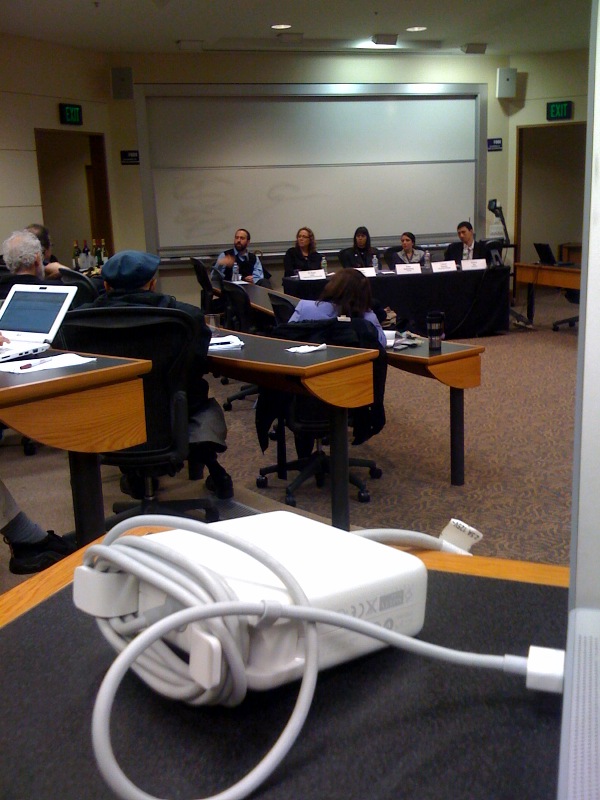
Intro: I’m attending a talk on privacy at SLS. No special reason I’m liveblogging this apart from me itching to give this liveblogging functionality a try. The talk is relevant to what I’m doing at work at the moment. The panel today comprises: Erika Rottenberg, General Counsel of LinkedIn;
Julie Martin, Associate General Counsel of Mozilla;
Jeremy Gin, Founder of Sitejabber; and
Lauren Gelman, Privacy Expert from Stanford’s CIS.


  5:02pm  •  Liveblog  •  Tweet This  •  Comments (2)  • 
25
Jan 10
Mon

Profile on David Tepper

Bloomberg profiles David Tepper, who runs Appaloosa Management, which is responsible for managing the best performing hedge fund (with AUM of $1 billion) over the first ten months of 2009.  During that period, the flagship Appaloosa fund returned over 117% (an appaloosa is a type of horse).

Tepper has lived with his wife, Marlene, in the same spacious, stone-faced contemporary house in a nearby town since 1991. He owns no vacation homes. His three children either graduated from or still attend local public schools. He coached their softball, baseball and soccer teams. …

While Tepper is pleased to have done so well in 2009, he remembers the mistakes of 2008 just as vividly [when his fund lost almost 30%]. …

David Alan Tepper started modestly. He was born in Pittsburgh in 1957 to Harry Tepper, an accountant, and his wife, Roberta, an elementary school teacher. He grew up in a redbrick house in the neighborhood of Stanton Heights. One of his hobbies was collecting baseball cards — and impressing his friends by spouting statistics on the local Pirates and other teams.

“My memory is almost photographic, not quite,” Tepper says. “It drives my analysts crazy.”

Nevertheless, he was an indifferent student at Pittsburgh Peabody High School, he says, and something of a class clown. He remembers being kicked out of one class and told by the teacher, “Go roam the halls and act like the animal you are.”

Tepper began buying penny stocks in high school, sometimes conferring with his father on the subject. As a student at the University of Pittsburgh, he got more sophisticated, developing a system for options trading that helped pay his expenses.

He graduated with a degree in economics in 1978. Later he enrolled in Carnegie Mellon University’s Graduate School of Industrial Administration. At his first presentation, in front of 150 classmates and the dean of the school, Tepper explained how changing one input variable wouldn’t affect the outcome of a particular equation.

“I don’t give a shit what you put in here,” Tepper told the class, tapping on the blackboard.

After a pause, his fellow students burst out laughing. At the annual student follies, they composed a song to the tune of the Dr. Pepper advertising jingle: “I don’t give a shit. Be a Tepper. Be like Tepper.”

  6:32pm  •  Business & Finance  •  Tweet This  •  Add a comment  • 

Academic Earth

Described by TechCrunch as “Hulu for Education”, Academic Earth catalogs videos of talks and lectures given at some of America’s leading universities on a huge array of subjects. There are also a large number of complete courses available.

You can hear people like Jeffrey Sachs talk on the Future of Globalization, or Larry Brilliant lecture on Strategic Philanthropy, or John Doerr speak on How to Negotiate Valuations.  Fantastic resource.

  11:19am  •  Internet  •  Tweet This  •  Add a comment  • 
24
Jan 10
Sun

  stuloh ran 3.52 km on 1/24/2010 at 5:13 PM with a pace of 5'42"/km http://bit.ly/5cxNB6

  6:05pm  •  Tweet  •  Tweet This  •  Add a comment  • 

Apple’s week ahead

Big week ahead for Apple. Tomorrow (1.30pm PST) it announces its Q4 2009 (fiscal Q1 2010) financials. The effect of earnings announcements on stock prices is all about market expectations. It seems that Apple is typically conservative when issuing profit guidance (or perhaps more accurately, infamous for low-balling). Analysts caught on long ago and have adjusted their expectations accordingly, but it will be interesting to see how well Apple actually did.

Here is an interesting article about Apple’s price movements at market close last Friday, and an even more interesting one on shorting of Apple stock.

On Wednesday, Apple is expected to release its tablet. Analysts have forecasted a tablet product could add several billion dollars to their top line. People will be looking at pricing point of the tablet and what it actually does on Wednesday (10.00am PST), but the bar set pretty high. Let’s hope it doesn’t cost $1000.

Apple needs to pull something out of the bag with this one. People are expecting a larger, cooler iPod – all the rumored features are nice and modern, but not revolutionary. The iPhone already does a lot. It needs to be more than an iPhone with a bigger screen.

Perhaps they are focusing more tying lots of licensed content into it, since it seems to be a media device that is aimed at tackling the Kindle market (and more), and that will enable them to do really cool stuff – a universal media library. Perhaps they have a new UI. Perhaps will be able to sense certain proximate devices like Microsoft Surface.

I expect to be able to use the tablet as a universal remote, as a substitute for the morning newspaper, watching  TV on the go, an exercise book in meetings. I expect to be able to hang the thing on a wall and hook it up to something which reports real-time information (like Seesmic Look, a Flickr feed, or a stock ticker). I expect to be able to use it for even cooler augmented reality applications (especially games!).

23
Jan 10
Sat

  stuloh This is outrageous, Tony Abbott. Because, y'know, non-migrants don't break the law ever. http://bit.ly/8o8Zes

  9:58am  •  Tweet  •  Tweet This  •  Add a comment  • 
21
Jan 10
Thu

  stuloh The #deepend, the new TV series about 1st year biglaw associates, is a total car wreck. Really accurate rep of life as a corp lawyer. Not.

  11:58pm  •  Tweet  •  Tweet This  •  Add a comment  • 

The Mpemba effect

Can hot water freeze more quickly than cold water? Of course, when you pose a question as absurd on its face as that, the answer is going to turn out to be yes.


This phenomenon is called the Mpemba Effect, after the Tanzanian high school student who observed it.

In the demonstration video above, I thought that the near-boiling water froze more rapidly because when it was thrown up in the air, it dispersed into smaller particles of steam or vapour (I’m not sure why this happens, but there are videos showing people emptying containers of boiling water in Antarctica, only to have the water go up in vapour before any of it hits the ground). Despite having a higher initial temperature, these smaller particles are much easier to freeze due to the greater overall surface area to volume ratio. On the other hand, the cold water comes out as one body of water.

While that was probably one contributing factor, the same effect is achieved if you place two containers of hot and cold water into a freezer without disturbing them. So, it turns out that the answer is not quite so simple.  Wikipedia says:

According to an article by Monwhea Jeng: “Analysis of the situation is now quite complex, since we are no longer considering a single parameter, but a scalar function, and computational fluid dynamics (CFD) is notoriously difficult.”
This effect is a heat transfer problem, and therefore well suited to be studied from a transport phenomena viewpoint, based on continuum mechanics. When heat transfer is analyzed in terms of partial differential equations, whose solutions depend on a number of conditions, it becomes clear that measuring only a few lumped parameters, such as the water average temperature is generally insufficient to define the system behaviour, since conditions such as geometry, fluid properties and temperature and flow fields play an important role. The counterintuitiveness of the effect, if analyzed only in terms of simplified thermodynamics illustrates the need to include all the relevant variables and use the best available theoretical tools when approaching a physical problem.
  5:25pm  •  Science & Technology  •  Tweet This  •  Add a comment  • 


ARCHIVES
2025: Jan
2024: Jan Feb Mar Apr May Jun Jul Aug Sep Oct Nov Dec
2023: Jan Feb Mar Apr May Jun Jul Aug Sep Oct Nov Dec
2022: Jan Feb Mar Apr May Jun Jul Aug Sep Oct Nov Dec
2021: Jan Feb Mar Apr May Jun Jul Aug Sep Oct Nov Dec
2020: Jan Feb Mar Apr May Jun Jul Aug Sep Oct Nov Dec
2019: Jan Feb Mar Apr May Jun Jul Aug Sep Oct Nov Dec
2018: Jan Feb Mar Apr May Jun Jul Aug Sep Oct Nov Dec
2017: Jan Feb Mar Apr May Jun Jul Aug Sep Oct Nov Dec
2016: Jan Feb Mar Apr May Jun Jul Aug Sep Oct Nov Dec
2015: Jan Feb Mar Apr May Jun Jul Aug Sep Oct Nov Dec
2014: Jan Feb Mar Apr May Jun Jul Aug Sep Oct Nov Dec
2013: Jan Feb Mar Apr May Jun Jul Aug Sep Oct Nov Dec
2012: Jan Feb Mar Apr May Jun Jul Aug Sep Oct Nov Dec
2011: Jan Feb Mar Apr May Jun Jul Aug Sep Oct Nov Dec
2010: Jan Feb Mar Apr May Jun Jul Aug Sep Oct Nov Dec
2009: Jan Feb Mar Apr May Jun Jul Aug Sep Oct Nov Dec
2008: Jan Feb Mar Apr May Jun Jul Aug Sep Oct Nov Dec
2007: Jan Feb Mar Apr May Jun Jul Aug Sep Oct Nov Dec
2006: Jan Feb Mar Apr May Jun Jul Aug Sep Oct Nov Dec
2005: Jan Feb Mar Apr May Jun Jul Aug Sep Oct Nov Dec
2004: Jan Feb Mar Apr May Jun Jul Aug Sep Oct Nov Dec
2003: Jan Feb Mar Apr May Jun Jul Aug Sep Oct Nov Dec
2002: Jan Feb Mar Apr May Jun Jul Aug Sep Oct Nov Dec
2001: Jan Feb Mar Apr May Jun Jul Aug Sep Oct Nov Dec
2000: Jan Feb Mar Apr May Jun Jul Aug Sep Oct Nov Dec
1999: Jan Feb Mar Apr May Jun Jul Aug Sep Oct Nov Dec
1998: Jan Feb Mar Apr May Jun Jul Aug Sep Oct Nov Dec