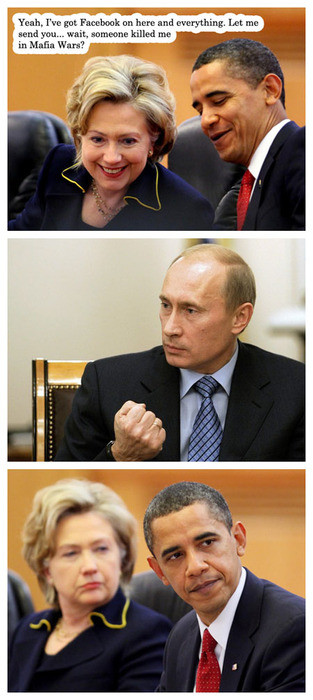
This is a fascinating, wonderful, entertaining presentation about the gaming industry: about the unexpected successes that have come out of it recently (such as Farmville, the Facebook app, which has more user accounts than Twitter, and the Wii Fit, a peripheral which generates a billion bucks for Nintendo), why they were successful, and where gaming will be headed. Well worth the 28 minutes.
So, back to these things. [Shows picture of a lot of different consumer electronic devices.] Now, well you might say that, “Well now wait a minute. Y’know, I’m not sure I’m buying all that authenticity stuff. It may very well be that technology is actually going to fix this through unification because we all know technologies converge.” There’s a bunch of crazy things going on here. But convergence is happening. Facebook is coming to the X-box … there’s gonna be one happy box, ahhh. Just like we used to have it in the old days. Remember when there was one happy box and we made games for it and that’s how it was? And because technological convergence will take us there and all this stuff is right now is just a temporary blip and we’re going to have technological convergence. And I am here to tell you that technological convergence is total bullshit. That is not how the world works. Technology is the opposite. Technologies diverge, they do not converge. They diverge like species in the Galapagos Islands. They branch out and branch out and branch out. Your VCR wasn’t able to record radio programs, and your Tivo can’t record stuff off the internet. I just got a Flip video thing and I’m like, “How do I take pictures?” and they’re like, “No, no, video only.” And I’m like, “Oh, okay.” Because that’s what technologies do – they diverge, they diverge, they diverge. So we’re going to have all this divergence …
And you might say, “Wait, wait, wait a minute. That’s not true: I have an iPhone. I have an iPhone and it’s convergence all over because it’s a phone, it’s a camera, it’s got a zillion little apps, it’s a game thing.” And I’ll say, “Okay you got me.” You got me but only because of the pocket exception. Pockets turn the law of divergence inside out… not the pocket, but the law. And this is not the first time, right? Remember the Swiss Army Knife, right? All the iPhone is is a modern digital Swiss Army Knife, right? And the Swiss Army Knife is really useful in the pocket – look at all that stuff converged in there. But if I got you one for your kitchen, you’s think that was the stupidest thing ever, because it doesn’t fit in your pocket. And this is why everyone hates the iPad. It’s a giant digital Swiss Army Knife, which is just stupid.
… and here’s the follow-up from Ctrl-Alt-Del.
It’s not often you see a corporate lawyer getting a standing ovation, much less seeing one at TED getting a standing ovation. Philip Howard, a partner at Covington & Burling, gives a compelling speech about a 4-pronged approach to fixing a society paralyzed by CYA-syndrome.
However, as important as identifying the right course of action is, the trick is, as with so many things, in the execution. The legal system is something which is ingrained in the very culture and fabric of a society – consider that in the US, there is reportedly 1 lawyer per 250-350 people, but in Japan there is about 1 lawyer per about 8,200 people. It’s not because no one wants to be a lawyer in Japan (on the contrary, bengoshi are highly respected, and until recent years, bar passage rates were at the 2-3% mark), it’s because the Japanese handles disputes differently to Americans (and that’s what the legal system is – a dispute resolution mechanism of last resort). Now that I think of it, it might also be the reason why the Japanese can get away with things like this. Accordingly, widesweeping change to the legal system comes neither easily, nor quickly. It either happens gradually, or if it happens quickly it’s in response to a crisis. Still, nothing wrong with daring to dream.
 I was thinking about copyright footers the other day (…yes, I know). They’re the little notes you see at the bottom of webpages with the © sign. You may have already heard somewhere that the © sign doesn’t really mean anything – it denotes that something is copyrighted, but it doesn’t normally need to be there in order to copyright something.
This is because copyright automatically attaches to copyrightable material as soon as it is authored. Historically, some countries required the copyright symbol to be affixed to stuff before copyright would subsist in it, but countries which signed up to the Berne Convention (most of the world) abolished this requirement.
However, if you look around the web, you’ll see copyright footers are still ubiquitous and come in a variety of different forms, for example:
© 1996-2010, Amazon.com, Inc. or its affiliates
© 2010 Twitter
Facebook © 2010
© 2010 YouTube, LLC
©2010 [on Google.com]
Copyright © 1995-2010 eBay Inc. All Rights Reserved.
© 2010 Microsoft
Copyright © 2010 Apple Inc. All rights reserved.
Copyright © 2010 Yahoo! Inc. All rights reserved.
© 1996-2010 Morrison & Foerster LLP. All rights reserved.
©2003-2010 Fenwick & West LLP
You’ll notice that there are several variations. Some include “All rights reserved.” Some include the company’s common name (eg, Microsoft), and others the company’s full legal name (eg, Yahoo! Inc.). Some include the word “Copyright”, and they all include a year or a date range, although I have also seen notices without any date.
So, if all of this is unnecessary, why bother at all? The notices do serve one useful purpose: to give notice (duh).
Copyright notices alert viewers that they are looking at copyrighted material, which is owned by someone else. So if a viewer wants to do anything with the material which encroaches on the owner’s (intellectual) property, they should get permission first. The notices are there for the same broad reason supermarkets put up signs saying “Slippery floor” with a little picture of man in the process of stacking it – to inform passers-by. Also, to continue the analogy, the floor is wet without or without the sign – putting the sign up doesn’t make it so. The other reason is that it’s common practice. It’s almost like a social convention. We see that little circled C everywhere, so the web designer thinks it needs to be included and up it goes.
But what does all the other gunk mean?
The company name is useful in identifying who is asserting ownership the copyright. It lets people know who to approach to ask permission. A full legal name gives you the exact identity of the owning company. A “common name” may lead to a bit of uncertainty, especially in corporate groups, where there are a bunch of related subsidiaries (for example, does Microsoft mean Microsoft Corporation, or Microsoft Licensing, GP, or even some other Microsoft company in a totally different country?). If you’re Twitter Inc., however, and you only have one company, then there’s little possibility of incorrect identification if you just say Twitter. (Actually, I have no idea whether Twitter has any subsidiaries or holding companies.)
Spelling out “Copyright” appears to be completely superfluous. I imagine it’s there just by convention.
The date normally identifies when the copyrighted material was first published. Copyright has a shelf life. Normally it’s linked to the publication date on one end and the lifespan of the author, plus a period of years, on the other (so the author’s great-grandkids can keep collecting royalties long after great-grandma has kicked it). In the US, the copyright term keeps getting extended, mainly to protect Mickey Mouse. Corporate authors get a fixed term too.
I’m not sure why some companies use a range of dates, but it’s probably to indicate that the website contains a variety of material published on different dates. It also can be used as a subtle marketing tool to show roughly how long the company has been around (1995 for eBay, circa 1996 for Amazon).
The term “All rights reserved” has a bit of history behind it. Apparently, it was a product of the 1910 Buenos Aires Copyright Convention, which was a treaty between the US and various Latin American countries, containing a requirement that:
“The acknowledgement of a copyright obtained in one State, in conformity with its laws, shall produce its effects of full right, in all the other States, without the necessity of complying with any other formality, provided always there shall appear in the work a statement that indicates the reservation of the property right”
The “statement that indicates the reservation of the property right” was standardized to “All rights reserved”. Adding those three words ensured that an angsty poet sitting in America, now owned copyright in not only the US, but also in a bunch of Latin American countries as well.
Today, all the Buenos Aires Convention members signed up for the Berne Convention, which deems that all rights are automatically reserved, unless a statement is made otherwise. This rendered the words “all rights reserved” irrelevant yet they are still everywhere. Like elevator door closing buttons.
You may notice that it’s phrased as “all rights” (plural). This is because copyright is actually a general term which encompasses a bundle of rights which can be split up and individually manipulated. This bundle differs depending on the medium of the material. For books, for example, there is a distribution right, a reproduction right, a right to publicly display the work, a right to publicly perform it, and so on. The exact bundle of rights also differs between different countries. Countries also differ in what they allow to be copyrighted (although the Berne Convention requires all its members to permit copyright for certain types of subject matter, like “literary works”… although countries quibble when they differ in their interpretation of what a “literary work” is).
You may also notice that some people play around with those three used-to-be-magic words. Creative Commons uses the phrase “some rights reserved”, which is an accurate characterization of the copyright status of material licensed under a CC license. People who wish to assert less than complete pwnage of their intellectual property also use the term “copyleft” as a descriptor.
Work released directly into the public domain (ie, where the author has relinquished their copyright) sometimes uses the tongue-in-cheek designation of “No rights reserved”.
The Berne Convention effectively abolished formalities (like adding a © symbol) as a condition for copyright protection. This position has annoyed certain companies and certain academics who argue that this blanket application of copyright, even for drivel, long lost forgotten works, and even Tweets*, is stifling the flow of information in society. Sometimes we can’t use copyrighted material because the author is uncontactable, or dead, or whatever, and the would-be user can’t get the requisite permissions. One proposed solution is to make people register certain works before they receive copyright in them – the registration process is a “formality”. But I am digressing now.
Finally, the word order in the notice doesn’t really matter, except for readability purposes. You could conceivably write: “All rights reserved. Your Mum (C) 1980, 1982-2010. Copyright.”
Ok. I think that’s my cue to end now.
* A recent blog post by Zeldman boldly declares that Tweets are not copyrightable. I personally disagree. As does Arment, who also makes a oft-argued (if flawed) point about people abusing the DMCA take down notice procedure rendering the issue of whether something is really copyrightable, moot – at least in the online environment. Bill Bonk has written another legal analysis on whether Tweets are copyrightable and I think his conclusion is spot on.
† Thanks to Daryl and Hugh for their input on this post.
 stuloh This episode of The Deep End has astoundingly bad law. I am astounded.
 (0)
(0)
(0)
(0)
(0)
(0)The Gramm-Leach-Bliley Act contains provisions aimed at protecting the privacy of certain nonpublic personal financial information. EPIC explains how a Victoria’s Secret catalog was a catalyst for the enactment of federal financial privacy laws:
Critical support for the Markey Amendment [an amendment to the GLBA which added privacy protections] came from Representative Joe Barton (R-TX). Barton expressed concern that his credit union had sold his address to Victoria’s Secret. Representative Barton noted that he started receiving Victoria’s Secret catalogs at his Washington home. This was troubling—he didn’t want his wife thinking that he bought lingerie for women in Washington, or that he spent his time browsing through such material.
Barton explained that he maintained an account in Washington for incidental expenses, but used it very little. Neither he nor his wife had purchased anything from Victoria’s Secret at the Washington address. Barton smelled a skunk; he reasoned that since he spent so little money in Washington, his credit union was the only business with his address.
(0)
(0)
(1)
(0)Malcolm Gladwell’s New Yorker article, “The Sure Thing“, examines the popular conception that entrepreneurs are risk-takers and concludes that successful entrepreneurs are actually risk-averse. Or, cast in another light, entrepreneurs only seem to be risk-takers, because they jump on hidden opportunities that everyone else is ignorant about (and what’s unknown is risky). However, they have done everything from their perspective to actually mitigate their risk.
“The risk-taking model suggests that the entrepreneur’s chief advantage is one of temperament – he’s braver than the rest of us are. In the predator model, the entrepreneur’s advantage is analytical – he’s better at figuring out a sure thing than the rest of us.”
Gladwell recounts the stories of various entrpreneurs, including Ted Turner (who was adept at getting good deals for himself), Sam Walton (who initially financed Walmart with money from his in-laws, which was less risky than a bank loan), and hedge fund manager John Paulson, who made $15 billion in profit in 2007 and $5 billion in 2008, by buying up credit default swaps on subprime mortgage bonds. In all of these cases, the decisions made by the entrepreneurs were not a seat of the pants thing, but bets made after careful calculation.
Entrepreneurs, or at least the good ones, may actually be quite risk averse.
“When the sociologists Hongwei Xu and Martin Ruef asked a large sample of entrepreneurs and non-entrepreneurs to choose among three alternatives – a business with a potential profit of five million dollars with a twenty-per-cent chance of success, or one with a profit of two million with a fifty-per-cent chance of success, or one with a profit of $1.25 million with an eighty-per-cent chance of success – it was the entrepreneurs who were more likely to go with the third, safe choice. They weren’t dazzled by the chance of making five million dollars. They were drawn to the eighty-per-cent chance of getting to do what they love doing. The predator is a supremely rational actor. But, deep down, he is also a romantic, motivated by the simple joy he finds in his work.”
And why do so many successful entrepreneurs keep working even though they never need to work in their lives again?
“…one undisputed finding in all the research on entrepreneurship [is that] people who work for themselves are far happier than the rest of us. Sane says that the average person would have to earn two and a half times as much to be as happy working for someone else as he would be working for himself. And people who like what they do are profoundly conservative.”
The founders of the company I work at sold most of their shareholdings in it for an amount that guaranteed that they would never have to work again in their lives. Yet, they are still working at the company, doing what they enjoy. Another insightful Gladwell article.
It’s been too long time since I’ve read a book. I picked up a copy of Hank Paulson’s On the Brink this week. It’s a very good read, and Paulson gives a gripping day-by-day account of his time as Treasury Secretary.
He received a lot of bad publicity over the closing months of his tenure for implementing TARP and other bailout plans, but this book puts into perspective just what he, and his department, had to contend with. In the last half of 2008, the financial world was rocked with crisis after crisis, and Paulson was at the center of it all – running around trying to do deals with banks, regulators, and Congress, while also in the midst of an election campaign. Many times Paulson was in the thick of dealing with one crisis when another hit. I even found myself thinking, “You can’t be serious!” whenever more bad news was delivered. Paulson and his team had to actually deal with it all.
He regarded that period as tougher than anything he ever had to do during his 30+ years at Goldman Sachs, and goes so far as to recount the occasional bouts of dry retching he endured as exhaustion and stress caught up with him.
Two interesting things occurred to me. Paulson goes to great lengths to cast President Bush in a positive light. Bush is depicted as always supportive, helpful, and even insightful. But to me the praise was a little too overdone to the point that it felt hollow. Bush’s credit mainly stemmed from him getting out of the way and letting Paulson do his job. Pelosi’s portrayal didn’t fare as well. (There’s a scene where his staffers are pulling all nighters in chaotic ad hoc offices on the Hill, running on take away pizza and diet Coke. Paulson goes to Pelosi’s office to speak with her, and everything there is prim and proper, and far away from the crisis happening outside the door. Someone takes his cup of Diet Coke away and pours it into a glass, and Pelosi says, “We don’t drink out of plastic cups here.”) Nonetheless, the book is still reasonably politically balanced as Paulson recognized that he needed the support of both parties to “save the US economy”.
The other striking thing was that many of the emergency powers held by the Fed and FDIC could only be exercised if there was a crisis that threatened the systemic integrity of the financial system. However, just about every institution mentioned in the book turned out to be “systemically important” – not just one or two, but over a dozen were on the brink of going belly up (and, as Paulson believed, the rest of the global economy along with them). There really are a lot of private institutions which are “Too Big to Fail”.
I recommend this book if you’d like a candid insight into what happens at the highest levels of the financial industry and political world. In early October 2008, I was in New York, feeling disturbed as I watched the markets turn to shit on Bloomberg. It was very late in the night, and I remember walking over to my hotel room window, which looked towards New York’s financial district. I wondered what the bankers were doing at that moment because I was sure a lot of them were pulling all nighters, trying to save something or other. I don’t have to wonder any longer, because this book tells that story.
Spoilers.
(0)| 133 days spent in current location | |
| Previously | Copenhagen, Denmark |
| » Currently | San Francisco, CA (21/12/25 4:37pm) |
| View full itinerary... | |


 1:10am