Counting down the days
Went to Alcatraz today and had a nice dinner at Chez Panisse in Berkeley (review to come).
Tomorrow, a closer look at the Golden Gate Bridge…


Went to Alcatraz today and had a nice dinner at Chez Panisse in Berkeley (review to come).
Tomorrow, a closer look at the Golden Gate Bridge…
Firstly, the four and a half hour flight from Chicago to San Fran did not come with a meal – United wanted us to pay $5 for a snack box. Secondly, when we got into San Fran at around noon, our bags did not appear on the baggage carousel. Turns out that United screwed up with the handling of our baggage. Our backpacks ended up on some other flight. We were promised the bags would be delivered by 8.00pm that day. However, that was yesterday…
While browsing Chicago’s “Magnificent Mile” – a long section of Michigan Avenue lined with boutiques and other expensive stores – I stumbled across Chicago’s Apple store. I went in to use the free net access there (or here, rather) and overheard a lady complaining to a staff member about her damaged iPod. I glanced over and it was a older generation iPod with a disturbing amount of sand stuck behind the click-wheel surface and behind the display glass. I couldn’t quite catch the whole conversation between the staff member and the woman, but at one point he blurted out rather loudly, “So you want us to print an advisory warning saying not to rub sand on your iPod?!“
Extended stay in San Francisco by two days, will now be back home on the morning of November 3rd. Toronto is probably the city that I’ve found to be the most similar to Sydney, except that it’s fricking cold and windy here.
United Airways sucks. We rang up their hotline to change our flight times and didn’t have certain information on us at the time, so we said “sorry, I don’t have that number on me at the moment”. The extremely rude reply came as, “No need to apologise. I don’t think you were being sincere anyway.” A second incident was on board the plane when Dorian leaned over to take a newspaper from a newspaper trolley passing by. Instead of saying, “Sorry sir, you can’t take a newspaper at this time,” (or similar), Dorian’s hand was physically swatted away by a disgruntled stewardess, followed by a stern “NUH-UH!”. Fly United? NUH-UH.
 (0)
(0)Boston was a good change from the rush and bustle of New York. It’s a quiet city, which I guess means less distractions for the students at Harvard and MIT which are across the river in Cambridge! The highlight for me was the Mapparium, a 10 metre high globe made of stained glass windows with the map of the world as it was circa 1935. There’s a bridge suspended through the middle of the globe through the Indian and Pacific Oceans and you get to pore over the world as it was when colonialism was still very much in fashion. The globe reveals many things which show how much has changed over the last 70 years: the full scale of the Soviet empire, the carving up of vast tracts of Africa between the European powers, a united India (before Pakistan and Bangladesh were separated out), the complete absence of Laos, Vietnam and Cambodia from the map (all come under the label of French Indochina), a China without Manchuria and so on.
The other interesting aspect of the Mapparium is its acoustic qualities. A “whispering gallery” consists of a circular wall which reflects sound waves along its surface such that sound travels a full circle back to the speaker. A whisper along the wall can be clearly heard by anyone listening along the wall’s circumference. There are many whispering galleries around the world, such as in St Paul’s Cathedral in London, or the Echo Wall in Beijing’s Temple of Heaven. However, the Mapparium is different in that speaking in any direction, since it is a full sphere, will result in the same effect. Furthermore, standing in the middle of the sphere and speaking produces the unnerving effect of hearing yourself in surround sound with startling clarity.
We also had the chance to catch up with Danny, who is on exchange at Boston College, for an enjoyable dinner. We concluded that European men seem to have a peculiar (and somewhat unsettling) habit of walking around bedrooms in underwear and socks and nothing else.
Currently enjoying a restful stopover in Montréal with the wonderfully hospitable Frances and Frances. Unfortunately the clouds have decided to follow us around and since we left New York every day has been overcast and rainy. It’s a pity really, because Montréal would otherwise be a very nice city to walk in. It really doesn’t have any “grand sights” like a castle on a hill (though it does have a chalet on a hill, which the locals call “the mountain”), but nonetheless has a certain charm to it. One aspect of this city that I find particularly charming and somewhat unique is the bilingual aspect of it (though something which I’m sure is shared by various European countries). Montréal belongs to the French-speaking province of Québec, but most locals are completely fluent in English as well (incidentally, this also means that many migrants to this city are trilingual). Signs are all in French, mostly with English written beneath in italics. Unlike France, however, locals don’t mind whether you make an attempt to talk in French or not. Anyway, hopefully the weather improves over the week. Apparently the progression of Autumn (or “Fall”, rather) means that the leaves on the deciduous trees are changing colour and thus the forests are quite a beautiful sight, but I haven’t been able to see this yet due to the constant rain.
Perhaps it’s the temperate weather on this visit, as opposed to the biting winter coldness, but I’ve enjoyed New York a little more on each subsequent visit. It hasn’t visibly changed much since I came here almost five years ago. Lots of WiFi hotspots and other superficial modifications, but apart from that it’s pretty much the same city.
Of course, except for the WTC. The WTC site is a gaping hole in the city, demarcated by a chain link fence with boards commemorating September 11 dotted around the site. Constructions on a new subway station are underway, but the building of an appropriate memorial site and skyscraper is proving to be much more controversial. The site is nothing much to look at, but it’s still worth a visit.
Yesterday a terrorism alert hit the media about a possible attack on the New York subway system. We went into a bank to change some traveller’s cheques and it was disconcerting to see on CNN terrorism reports pertaining to the city we were currently in, although I imagine New Yorkers are getting increasingly used to it. In response to the terrorism alert, the subways were swarming with cops (I had my bag randomly searched once) but with 4.5 million depending on the subs daily, the terror alerts weren’t deterring anyone from using them – least of all backpackers with no other means of transport. Meanwhile there was one guy selling newspapers outside a station who appeared to be getting quite frustrated by the lack of sales. At one point he was crying out, “Terrorism alert! Read all about it! … Hey, those cheap shoes are tickin’. I’m callin’ the po-lice!”
U2 is in town playing at the Madison Square Garden. We queued up for about three hours yesterday waiting for cancellation tickets. In the line we had the somewhat painful experience of listening to a local man who was some leftover remnant of the hippie era. His ramblings covered things like the time he smoked pot on the Great Wall, how everyone in the world is ignorant or stupid, how no one talks about “important” issues in the world anymore (including moving towards a four day work week), and most disturbingly, how Australia should cut down its Asian migrant intake to avoid dilution of its “culture”. It was a relief when we got to the ticket booth and parted company. Unfortunately, we found out that the only tickets left were US$170 ones and left empty handed.
At the Apple Soho store. Dorian looks around and goes, “The trendiness here is sickening!” Haha!
Fully sick scooters
Wrexes with basketball-sized mufflers and boot-sized sub-woofers with Greeks at the wheel going oonce-oonce-oonce up the street are a fairly common sight back in Sydney. It’s no surprise they’re around in Greece, either, but not everyone can afford a car. So they fall back on the next available thing: scooters. And since you can’t fit a sub-woofer on a scooter (or at least they haven’t tried yet), they tune these things up to deafen as many people as possible. These things make a helluva lotta noise.
But it’s a scooter. I’m sorry. You just can’t look cool on a scooter. Even Vin Diesel can’t make it look cool. And when you’re toting a peroxide blonde mullet and are going farting down the street on your pissy little shitmobile every night at 2am waking the neighbourhood up, you’re just retarded.
Restaurant touts
The great thing about eating in Athens is that there are so many outdoor eating places, and the weather is great for it. Fresh bread, large blocks of feta cheese atop crisp salads, copious quantities of olive oil and desserts dripping in honey. Yum. Part of the ritual of finding a place to eat is running the gauntlet of taverna owners who stand by the roadside demanding that passers-by sit down at their establishment for a meal. An example of one such invitation (spoken all in Greek) as Dorian and I walked by:
Restaurant owner: Come in and have lunch!
Dorian: We’ve already eaten.
Restaurant owner: Already eaten? Your friend doesn’t look like he’s eaten anything in his entire life!
Dorian: (Laughs)
Restaurant owner: Is he Japanese?
Dorian: (Laughs again)
Me: What? What’s so funny?
Sights around town
The central focus of Athens is… you guessed it, another citadel-on-a-hill-overlooking-town. Pretty much par for the course for Europe, but Athens’ Acropolis is unique in that its buildings are about two and a half millennia old. It goes without saying that it’s a world heritage site, and although most of it is covered in scaffolding, it really is a pretty impressive sight. The Acropolis also provides a 360 degree view of the sprawling metropolis of Athens, which is mostly homogeneous. A museum at the Acropolis houses some excellently preserved statues and friezes, all created centuries before the birth of Christ.
The sheer age of artifacts is what makes Athens interesting. Marble was used a lot in Grecian art. After such works have been restored they – apart from the odd missing limb or head – look much younger than the 5th century BC dating they have. Athens is full of such stuff and they keep discovering more. Locals are afraid to knock down and replace buildings because when they dig up foundations, they also keep digging up artifacts. When this happens, no further development is allowed on the land until everything’s been excavated. Understandbly, locals aren’t in a hurry to find out whether they’ve been living on top of an archaeological goldmine and so are quite content to live in aging apartments.
When the government laid new Metro lines, they too ran into the same problem. Near Syntagma station, they unearthed the remains of Roman bathhouse . So they dug a large hole to the surface, stuck a glass roof over it and turned it into a roadside exhibit. The Metro track had to be diverted. The smaller artifacts were moved into glass cases inside the Metro station. I don’t think anywhere else in the world has 2500 year old trinkets displayed in a train station.
Changing of the guard
I’ve seen the changing of the guard in several countries, and I thought the goose-stepping in Sofia was ridiculous, but the Greek soldiers stationed outside the tomb of the unknown soldier really take the cake. I present this:


The Islands
History aside, Athens really isn’t all that pretty. However, the Greek islands are another story. We took a high speed ferry to Mykonos which was about four hours away. As you approach it, the island makes its character instantly known – buildings dot the landscape with whitewashed walls and bright blue windows and doors. Mykonos hosts more than twenty beaches and in high season it gets absolutely packed. Being September, it was the shoulder season and we were lucky not enough to have to deal with crowds… especially as Mykonos is notorious for being a “gay island” hangout. The beaches are pleasant enough, but they can’t really be compared to Aussie beaches. The sand is not fine grained, but consists of small grey pebbles. The Aegean Sea, although a beautiful deep aquamarine colour, is as flat as a tack, and there are no waves to speak of on the beaches. Apparently the Greeks like it that way, but to me it’s a bit like sitting in a cold bath. But it’s a terrific place to chill out nonetheless, and that is what we did…
Sighişoara is small Romanian town of about 35000 people nestled in among the hills of Transylvania. It features a typical European castle-on-a-hill overlooking the town. Sighişoara’s is notable for being the birthplace of Vlad Ţepeş, otherwise known as Vlad the Impaler. Vlad’s house has since been converted into an overpriced restaurant where tourists can enjoy a steak (cooked rare, of course). A clock tower from the 17th century stands next to Vlad’s birthhouse. Unfortunately, the clock was not operation when we were there, but climbing the tower provides a great vantage point. At the top of the tower, the railings – on which is marked the reassuring words, “Do not lean” – have little plaques stuck on them noting the distance and direction of major world cities. Sydney is the most distant at over 15,000 kilometres. Down near the base of the tower is a piaţa where they used to, among other things, hold public executions. Today, it is filled with a variety of souvenir stalls selling everything from Romanian handicrafts to ultra-tacky Dracula memorabilia.
Sighişoara is not heavily touristed and although that made for a peaceful day, it seemed like most of the inhabitants had never seen an Asian before. I was stared at by a Roma boy all through lunch, which was quite disconcerting. Of course, the staring was mutual at times – especially when a bunch of Gypsies in a horse-drawn buggy went by on the highway (the horse conveniently defecating all over the road as it trotted past). However, later in the day, I passed by a bunch of youths who started making mocking Chinese-sounds – something I haven’t experienced in many years.
The next day, the weather had turned cold and overcast. We hopped on the train to Bucharest. At first, it was only wheat fields and hills – layered in different shades of grey by haze and distance. Poor light gave everything a moody, muted colour. As we moved out of Transylvania and closer to Bucharest, things got depressing. Agriculture and countryside slowly gave way to industry, and great rusted, stained hulks of factories and abandoned vehicles lined the railway side. Cottages were replaced by monolithic, dirty and overwhelmingly grey apartment blocks. When we finally rolled into Bucharest, the rain clouds had rolled in as well.
The rain was here to stay. It rained for four days straight, so heavily on the first two days that we were mainly stuck indoors. By the third day, the rains had resulted in some minor flooding around Bucharest, but were beginning to ease up and we headed into the city.
Grey, drab, and dreary, Bucharest really felt like the Eastern Europe of old. Bucharest felt like it was still mired in the past. Boulevardes link a series of piaţas through the city, but unlike the piazzas of Italy, most of them are voluminous cobblestoned areas which would be empty if the Romanians weren’t using them as ad hoc car parks.
Bucharest is not a city frequented by tourists, lacking information booths, English signs and any central tourist attractions. All the sights we saw were conspicuously devoid of tourists, including a decent replica of Paris’ Arc de Triomphe, called the Arcul de Triumf in Romanian (a lot better than the ugly four-sided replica in Vientiane, at any rate). We only visited one museum – the large Taranului Roman Museum which was mostly filled with unremarkable wooden artifacts, glass paintings, stone crosses and embroidered clothing. Overall, the feel was quite depressing, though the city was certainly interesting.
Romania only recently emerged from the shadow of a communist dictator’s rule in 1989. During the reign of Nicolae Ceauşescu, Romania was afflicted with economic turmoil, famine, torture and forced relocation as thousands of villages were uprooted in a program of rural urbanisation. Also during this time, Ceauşescu tore up the churches and booted some 70,000 citizens off their properties in order to use the land for his own dubious and ultimately failed land development projects. His incongruously named “House of the People” (now the Palace of Parliament) is one of the largest buildings in Europe, but it is a mammoth concrete monstrosity. Although impressive in size, it is devoid of any colour whatsoever. It stands on a stark piece of land with ill-kept gardens and next to parkland which is overgrown with weeds and polluted by rubbish. Bordering the park and palace is the B-dul Unirii. An entire suburb was destroyed in order to make way for what was intended to be Bucharest’s Champs Elysées. Ceauşescu even went so far as to make his boulevarde six metres longer than its Parisian counterpart, but his vision never really took fruition and B-dul Unirii is now aptly described as an “urban wasteland” by the Lonely Planet.
Ceauşescu was finally executed after an uprising in 1989. In the Piaţa Revoluţiei you can see the balcony where he made his final address to a hostile crowd. When you see how close the balcony is to street level, it becomes clearer why he left the building in a hurry via an airlift from the roof. The piaţa now has a memorial dedicated to those involved in the 1989 Revolution. Wikipedia has a good account of the Revolution.
Bucharest is really quite bleak by any city’s standards and compared to the Romanian countryside. It was not until several days later on the train that we got to talk with a local and confirm that Bucharest really was bleak and it wasn’t just because we weren’t visiting the right places.
The other thing about Romania is the high population of Roma, an ethnic minority facing much discrimination in the region. Roma are better known for being associated with the term “Gypsy”. Gypsies are much maligned all through Europe. In a store in Prague, I noticed that Cheryl’s backpack was not zipped up properly, and the shopkeeper did not hesitate to point out that “maybe the gypsies opened it up”. Officially the Roma population in Romania is about 400,000 out of the country’s 20 million, but it is reckoned that actual numbers are closer to 2 million. Romania certainly had a lot of them. In Bucharest, I had ducked into a bookstore and bought some postcards. As I was putting them in my bag, I noticed a group of gypsy boys staring at me intently through the window. I got spooked and decided to stick around the store for a little while longer. Half an hour later, they appeared to have left, but when I walked out, they suddenly emerged from behind a bunch of pillars. There is little that is more traumatising than a group of four gypsy children surrounding you and demanding money, hands roving all over the place. Luckily, my backpack was locked, so I shoved my hands in my pockets, blindly ran onto the road and into oncoming traffic, and made my escape.
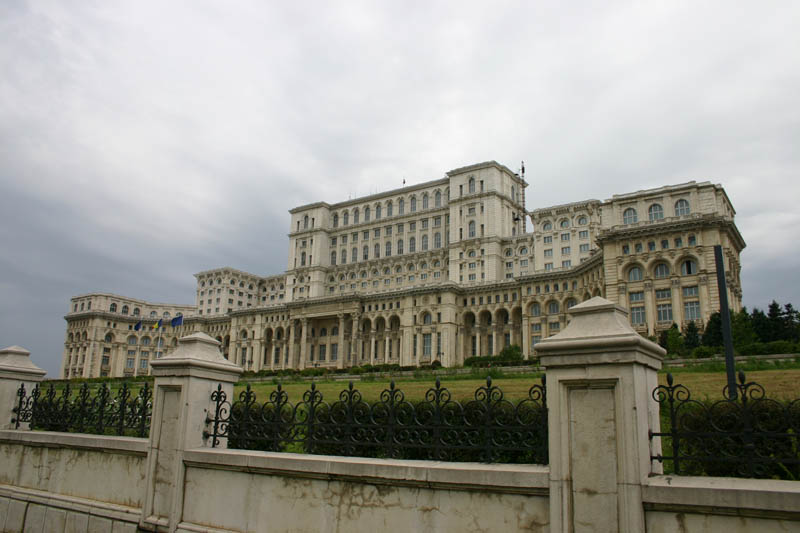
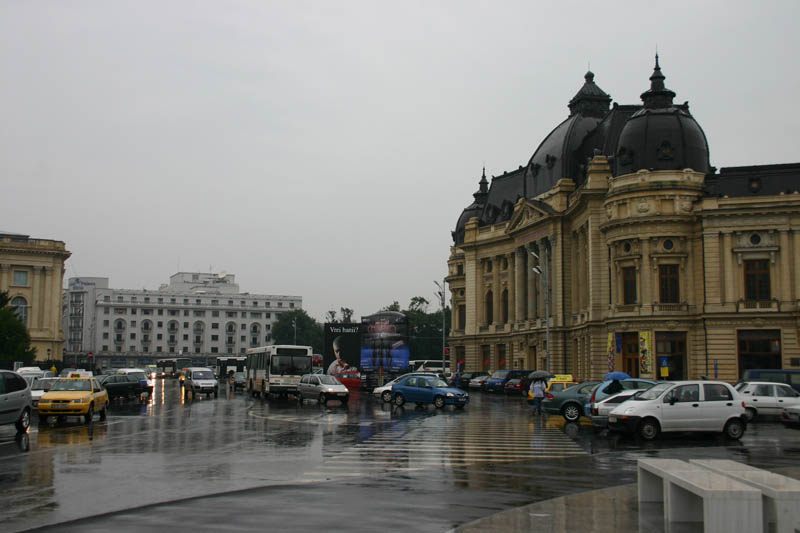
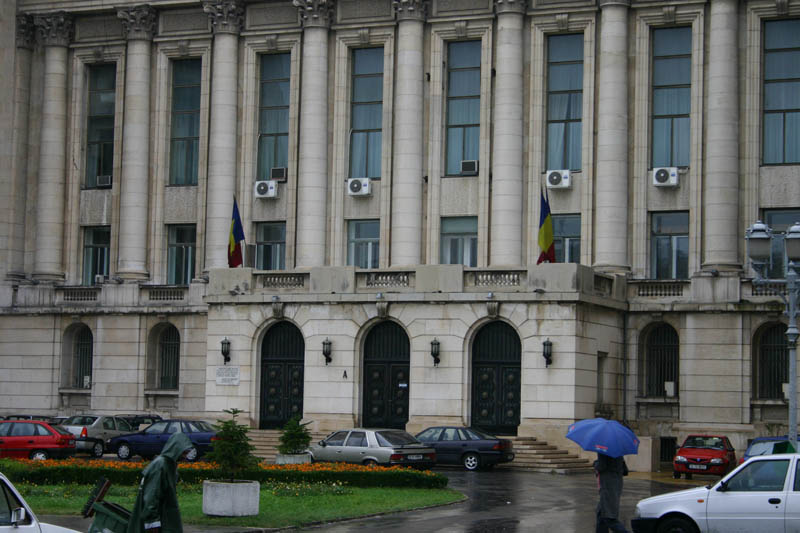
L: The monstrous Palace of Parliament
M: Piaţa Revoluţiei
R: Central Committee Balcony where Ceauşescu made his final speech
Train journeys can be a great way to travel and our path through Eastern Europe required several overnight journeys. As long as you have a reservation for a couchette or sleeper car, sleeping is normally not a problem. I find the rocking motion of the train quite soothing, actually. The only inconvenience is when you have to deal with border crossings. This involves a train stop in the middle of the night – once before reaching the border to get your passport stamped with an exit stamp, and once after crossing the border to get an entry visa. So, a typical scenario is getting woken up at 2.00am by one border guard, then later at 3.30am by the second. This can get quite annoying if something delays the process.
We visited Sofia after Bucharest. The trains we took into and out of Sofia were routes sufficiently obscure such that only backpackers seemed to frequent them. Going into Sofia we shared a compartment with Takeshi, a Japanese guy travelling solo (there seem to be a lot of solo Japanese travellers). A more unusual sight was a pair of girls from Hong Kong in the compartment next to us.
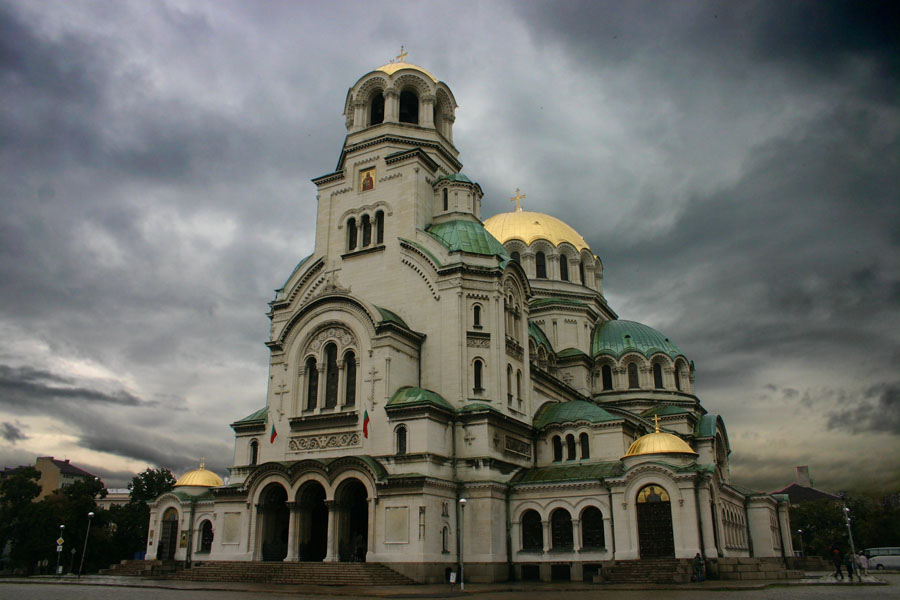
Bulgaria is probably at about the same level of economic development as Romania. However, not having gone through the same sort of turmoil Bucharest had gone through, Sofia is an attractive city. Many of its streets are paved with faded yellow cobblestones and in contrast to Bucharest, it has a large number of Orthodox churches scattered around the town. We also managed to see the changing of the guard, which features a ridiculous performance of goose-stepping, only outdone by the preposterous display the Greek soldiers put on in Athens. Although we were only in Sofia for one day, we quickly got a sense that Bulgarians were a warm and friendly bunch. In hindsight, it would probably have been better to spend more time in Sofia and less in Bucharest.
The Bulgarian language uses Cyrillic characters so the country felt very Russian (which is a little peculiar since it is almost like saying Hungary uses Roman characters so it felt very English). Interestingly, the Lonely Planet notes that Bulgarians nod to signal “no” and shake their heads to signal “yes”. Although this could produce some rather amusing opportunities for miscommunication, we never ran into any problems with this.
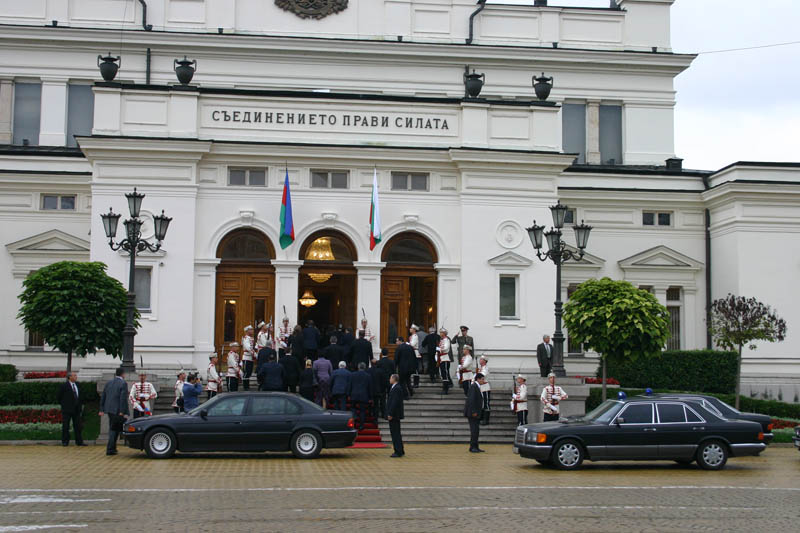
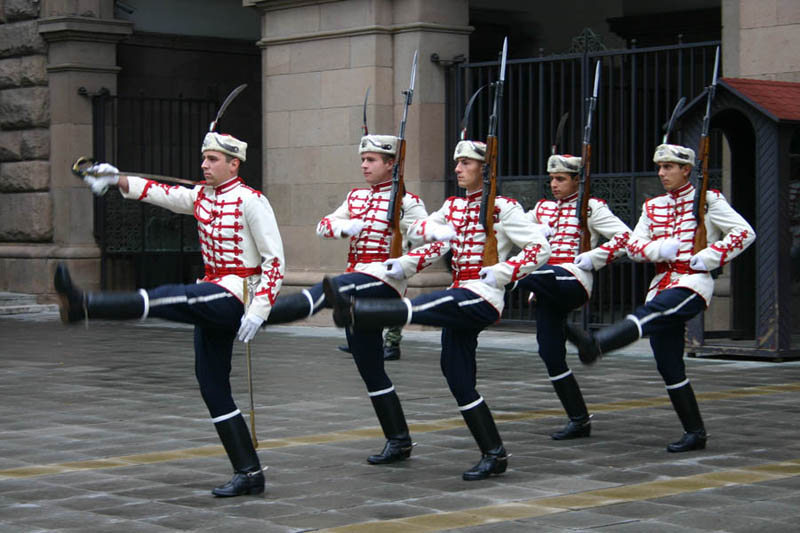
L: Foreign dignitaries arriving at the National Assembly
M: Alexander Nevski Church
R: Changing of the guard in Sofia
It was on the train from Sofia to Thessalonica that we met Ionut and his friend, whose name I won’t even attempt to spell. The two of them were both Romanian engineers who worked for Romanian Railways. As a perk of their jobs, they got to travel on the entire European train network for free. Utilising this deal, they had managed to visit a great deal of Europe – something which would not normally be feasible on a salary of about 300-400 Euro a month. To cut down on accommodation costs in Western Europe, they would arrive on an overnight train in the morning and leave on another overnight train in the night, taking a one-day whirlwind tour of a city.
Ionut’s English wasn’t very fluent and he had a habit of exclaiming something was “very fine” if it was to his liking. He wanted to visit Australia to see our crocodiles which were “very fine”, and our kangaroos, which were also “very fine”. However, on his salary – which was “not very fine” – getting to Australia just wasn’t possible.
On the other hand, Ionut’s friend, fed on a steady diet of movies on the TCM channel on pay TV, was fluent in English and very talkative. He was a great teller of anecdotes and jokes and seemed to have an endless supply of them, especially stories of his time in the Romanian army.
When we told him we’d recently been to Bucharest he immediately expressed his distaste. “I don’t like Bucharest. It’s very grey and boring. Ceauşescu destroyed everything. I come from the North, it’s much better up there.” He then told us another joke:
The Japanese built a car entirely out of gold and invited George H W Bush, Mikhail Gorbachev and Nicolae Ceauşescu to take a look at it. They came and had a look, but before they were allowed to leave, were searched by the Japanese police. Bush was searched first and when a gold screw was found in his pocket, he was summarily thrown in prison. Gorbachev was then found with a spark plug stuck down his pants, and he too was thrown into prison. Finally, Ceauşescu was frisked, but nothing was found and he was praised for his honesty. The next day Ceauşescu visited Bush and Gorbachev in prison.
“Why did they arrest you?” he asked them.
“I took a screw from the car as a souvenir,” Bush replied.
“And I took a spark plug,” Gorbachev said.
“Oh, fuck you!” Ceauşescu exclaimed. “No wonder why I couldn’t start the damn car!”
At around 3.00am we were woken up by the Bulgarian border guard. As we lay there bleary eyed, Ionut had in the meantime taken to pacing up and down the train carriage with a pack of cigarettes. He was nice enough to duck back in to let us know that he understood it was a non-smoking compartment, so that was why he was smoking outside. Unfortunately, while he was explaining this, he was waving his cigarette around, filling the compartment with a rather noxious smoke which lingered and made it very difficult to get back to sleep.
By 4.00am, the train still wasn’t moving. The border guard had discovered to their annoyance that someone in the next compartment didn’t have a Bulgarian visa in their passport. After a few tense moments of trying to figure out what to do, the unfortunate man was tossed off the train in the dead of night and we were off again.
One thing about travelling is how sudden changes of environment can be from one day and the next. By late that morning we had left behind the gloomy weather and foggy hills and emerged into bright sunshine, accompanied by the vivid Greek countryside with its stony cliffs, rolling plains and fields of olive trees, cotton plants and vineyards. We were back in the “West”.
Prague, Bratislava and Budapest are all old bastions of the Hapsburg empire. Each city has a hill overlooking the town and the Danube with a castle of some description sitting on the hilltop. So, that’s what I’ll start with in a brief roundup of each city.
The dominating feature of Prague Castle is St Vitus’ cathedral, a large cathedral with a impressive set of stained glass windows and chapels. We climbed the three hundred or so stairs to the top and were rewarded with a fantastic view of Prague and all its warmly coloured buildings and cobblestone footpaths. We caught the sunset on the famous Charles bridge at the bottom of the hill, a pedestrian-only bridge perpetually milling with tourists, portraiture artists and a variety of buskers. (Incidentally, the scene in the movie Eurotrip, where the group is sitting on the bridge in Amsterdam was actually filmed in Prague, very near the Charles Bridge.)
In the evening we listened to a performance of Mozart’s Eine kleine Nachtmusik and Vivaldi’s Quattro Staggioni by the Prague Chamber Strings at the National Museum at Wenceslas Square. A bit of a tourist trap, but a good recital nonetheless. Wenceslas Square is currently hosting a variety of contemporary art sculptures which are somewhat questionable in their artistic merit. Among the works of art were a model of Superman flying straight into a block of concrete (his head is actually embedded in it), an anatomically exaggerated abstract representation of the “relationship between men and women” (the man is actually balanced on his oversized appendage) and a row of men built out of metal and with balls of steel (literally).
The only disappointment about Prague was that the Astronomical Clock in the Old Town was under a three month long restoration when we visited. It was all covered up with scaffolding, but that didn’t stop a crowd from gathering under it and bitching about how unlucky they all were to have come at such an inopportune time.

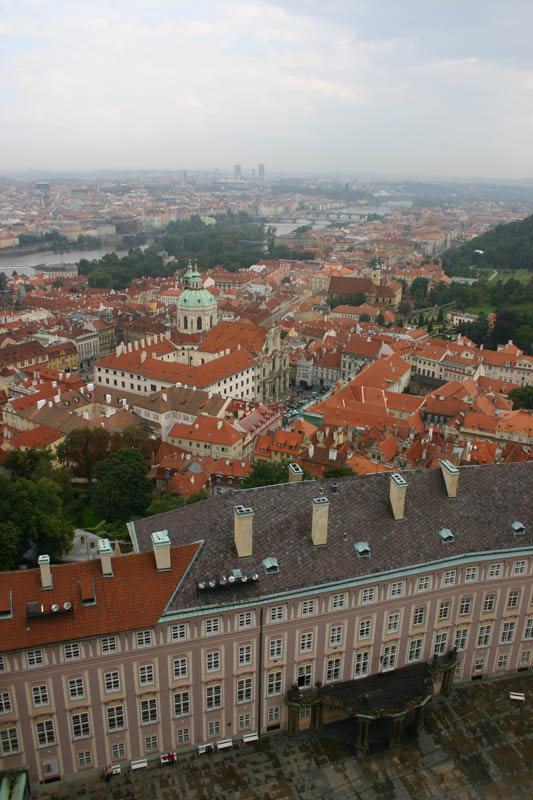
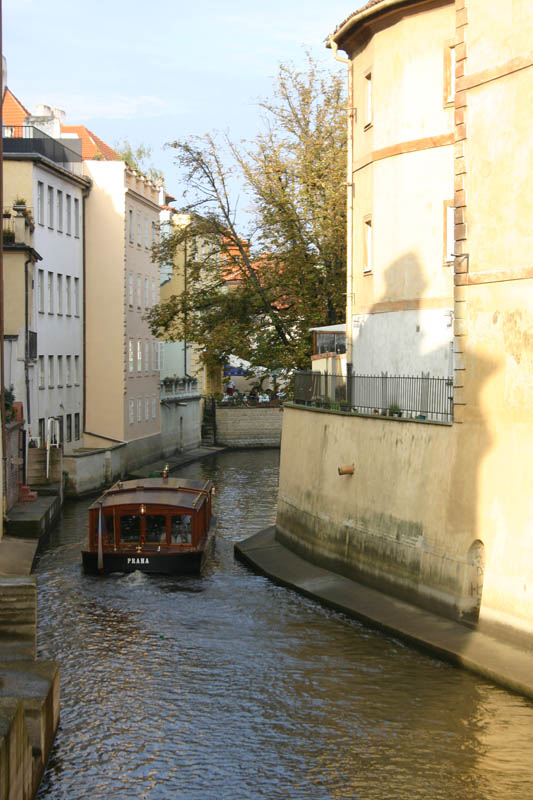
L: Cheryl and a guard at Prague Castle
M: View from St Vitus’ Cathedral
R: Near the Charles Bridge
Bratislava stands in contrast to Prague. Once part of Czechoslovakia, Slovakia peacefully became independent from the Czech Republic in 1993. Its capital, Bratislava, is the poorer cousin of Prague, being more compact and less visited. Bratislava Castle is a very plain building and seems to have been stripped bare and partially converted into offices. However, it does offer a picturesque view of the city. There is also a small museum in the castle which displays various objects found in the region from Roman times in nicely lit glass cases.
Bratislava’s city centre is a network of cosy pedestrian walkways, overflowing with cafes and restaurants and shares the same warmth of colours of Prague. Again, we had unfortunately visited during a period of heavy restoration – the town hall square had been uprooted, leaving an ugly hole and dysfunctional fountain in the middle of town.
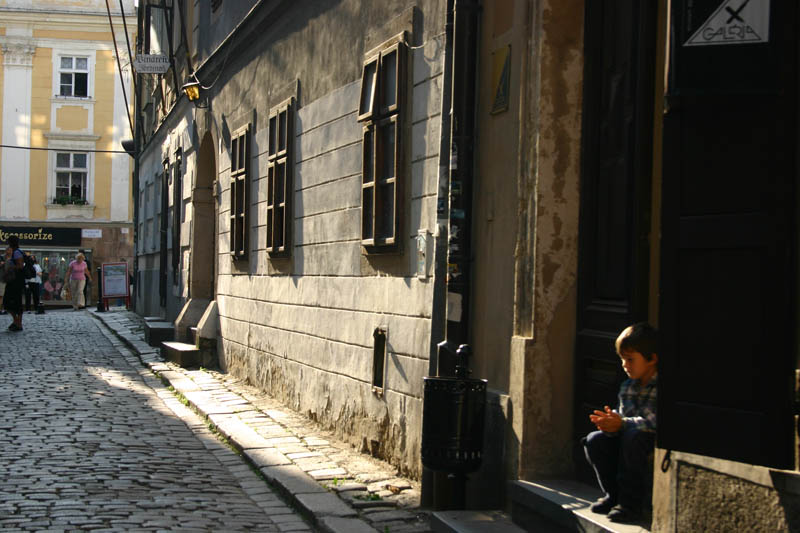
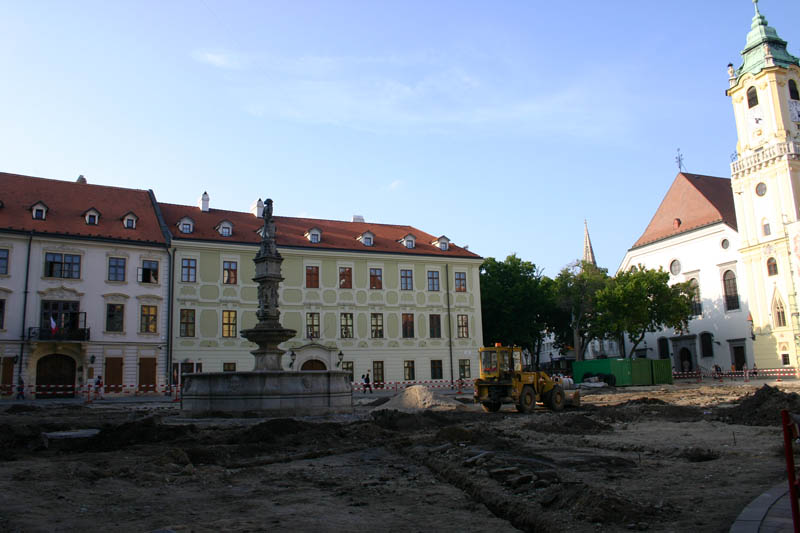
L: Bratislavan street
R: City centre
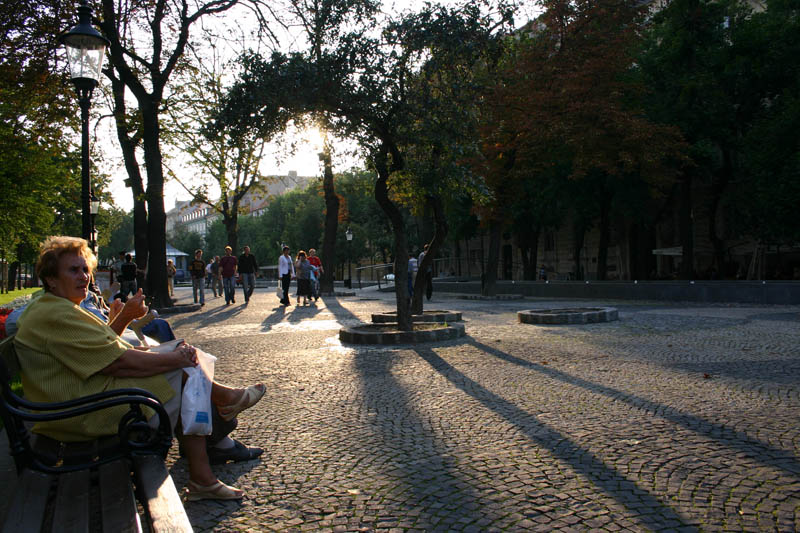

L: Park
R: Bratislava Castle
Budapest’s castle is more like a small town. It contains a variety of museums, churches, hotels, restaurants, a palace and the Fisherman’s Bastion. The Fisherman’s Bastion is a distinctive structure built of white stone a hundred years ago. It overlooks the Danube and was used as a checkpoint on The Amazing Race (where Gus and Hera were eliminated, if memory serves).
Reminiscent of Prague, after visiting the castle we made our way down the hill on foot and crossed the Chain Bridge, one of the bridges connecting Buda and Pest – respectively the Western and Eastern halves of the city. Rumour has it that the Chain Bridge’s designer was so assured that his bridge was perfect, he had resolved to commit suicide if it was proven otherwise. After the bridge was opened, it was discovered that the lions standing on the bridge corners lacked tongues and consequently the creator took his own life. This rumour was summarily dismissed during a boat tour we took on the Danube at night, when all the major buildings are lit up with floodlights. The boat tour’s pre-recorded commentary offered a surprisingly frank overview of the city’s history, including an appraisal of the Marriott Hotel complaining that it was “too big, the angles are bad and it looks like a fortress”.
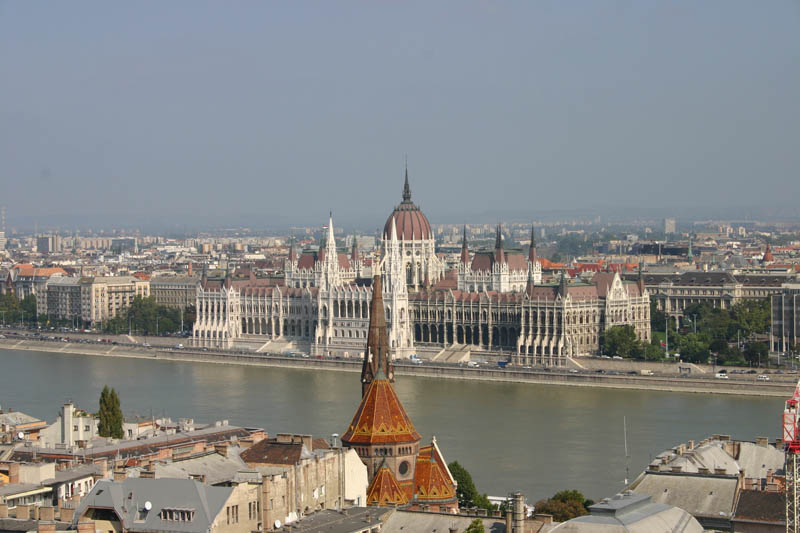
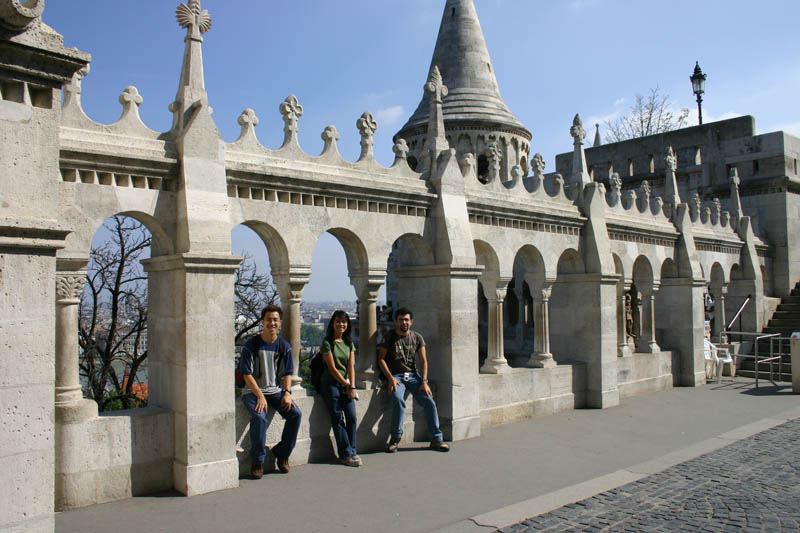
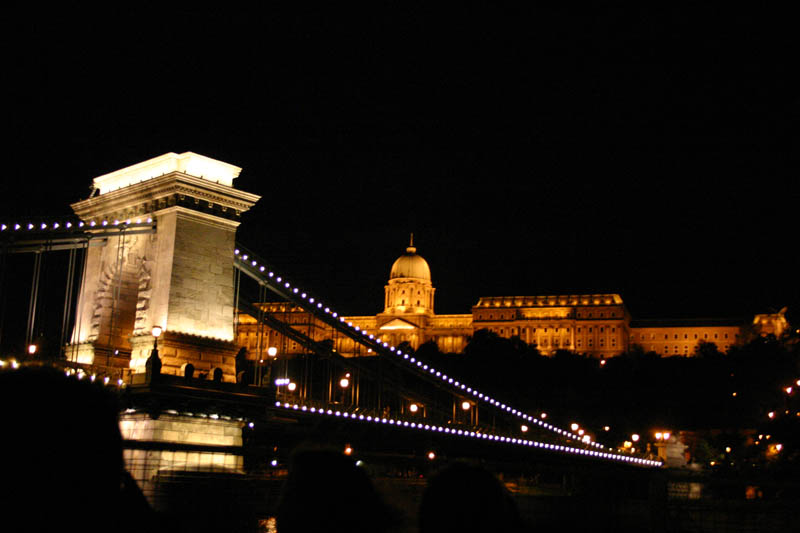
L: View over the Danube to Pest
M: Us at the Fisherman’s Bastion
R: Chain Bridge and Budapest Castle at night
Throughout these countries, the food was great. Hearty garlic and onion soups filled with melted cheese and served with a wide variety of fresh breads normally kick off meals. Main courses heavily focus on meat and gravy (with dumplings to mop up the sauce in Prague). Vegetables are normally ordered as side dishes because mains normally won’t come with them, maybe except for potatoes or sauerkraut. Beer is the standard drink during meals and is cheaper than soft drinks which come in ridiculously small quantities (200mL bottles!).
Interestingly, it is the custom to specify the weight of dishes on the menu. It is also customary to clear plates from the table as soon as possible, which means that you have barely taken your last bite when your dish is whisked out from under you.
From a travelling perspective, the three countries reminded me of Western Europe and all felt quite safe. Romania and Bulgaria proved to be an interesting counterpoint to the “Westernised vibe”…
(0)It was about 8.00am when this Jamaican train conductor sticks his head into our compartment. “Sighisoara? It’s the next stop. 9.30am.” There was at least one more hour of sleep left in the journey, so I just rolled over and shut my eyes.
We woke up at about 9.00am to the sight of Romania rolling by through the window. Romania is much more like the Eastern Europe I envisioned it to be. Cornfields dotted the landscape, occasionally punctuated by small villages which were composed of a group of dilapidated buildings with cracked walls, broken windows and little old gypsy women sweeping pathways with brooms made of sticks. Transylvania was misted over and the hills in the distance took on a hazy, dreamy and soothing complexion as we neared our destination.
The train chugged to an abrupt stop at 9.35am. At this time Dorian and I were still struggling with our backpacks in our cabin, so we had to make haste. We stumbled into the impossibly narrow train corridor where another train conductor inquired, “Sighisoara?” and pointed towards the exit on the other side of the carriage. I just nodded and made a beeline for the door. In the way were pieces of luggage and passengers bound for Bucharest, puffing on early morning ciggies. I can only assume they were still half-asleep because most of them inconsiderately refused to move out of the way, so we just brushed unapologetically past them and if our backpacks maimed them along the way, so be it.
When we got to the vestibule area, the train door was shut. “What the hell do we do?” Dorian asked. I managed to open the door, and just as I did so, the train started chugging forward again. “Shit! Jump!” Dorian yelled, and I readily obliged.
“Ah, nothing like a drama to start the day. At least we made it. Ok, let’s find our hostel.” Oblivious to the lack of signs identifying the train station, I forged onwards, not noticing Dorian becoming increasingly bewildered. I must have been distracted by the small gypsy boy who was after my bottle of peach iced tea. Sighisoara looked like it was in bad shape, with deserted streets and the same dilapidated buildings we’d seen on the train.
Out on the main street, the road signs weren’t quite matching up with what was in the Lonely Planet. The hostel was only meant to be 50m from the train station, but nothing resembling accommodation was in eyesight. Dorian observed that we had passed several buildings along the way marked with “Medias”.
“Uh, I think we might be in the wrong city.”
“Can’t be!” I replied. A few seconds later, we decided to head back to the train station information office to ask, somewhat sheepishly, “Where are we?”
The answer came back as dreaded, “Medias.”
Turns out we had jumped off the train about 35km too early and were in the village of Medias, a village which was noticeably absent from the Lonely Planet.
Luckily, there was an old regional train bound for Sighisoara only half an hour afterwards, and we finally reached our destination, slightly shaken, but otherwise fine.
Romanian Currency
One of the reasons why I refused to believe that we had got off at the wrong stop even though the streets weren’t matching those in the LP’s map was that sometimes the LP is out of date. We bought a copy of the Eastern European LP which was published in February of this year. When we got into Sighisoara for real, we went to the ATM. I was all ready to withdraw 10 million lei but I grew suspicious when the highest preset amount offered to me on screen was only 400 lei. I got cold feet and cancelled the transaction.
Turns out, as we discovered on a nearby poster, that only in July the Romanian government had decided to slash four zeroes off their currency. Had I not cancelled, I would have been attempting to withdraw about A$400,000.
A few quick words while we wait for Cheryl to arrive from the airport. Prague was very pleasant. It’s a relatively quiet town, quite picturesque with buildings painted in warm colours. There are also plenty of cobblestone roads which are impractical for both pedestrians and vehicles, but at least they look nice. The people of Prague seem to talk with a great deal of gusto. Upon inquiring whether a money changer could break a large banknote, Dorian was gruffly chastised, “No, it is IMPOSSIBLE!” Upon inquiring whether her youth card could qualify her for a concession, Cheryl was told it was, “PERFECT!”
On another occasion, we had a sudden craving for some dessert so we ducked into a delicatessen to inquire if they had any strudel. All we got in response was a confused look and a quizzical, “What?” With more bravado and persistence than I could dare to muster, Cheryl kept repeating “Strudel?” in various intonations to an increasingly puzzled shopkeeper. Finally, after about the fifth “Strudel?” he snapped as if we had insulted his mother’s honour and, with arms outstretched, he boomed, “Strudel? WHAT IS THIS?” Cue our hasty exit.
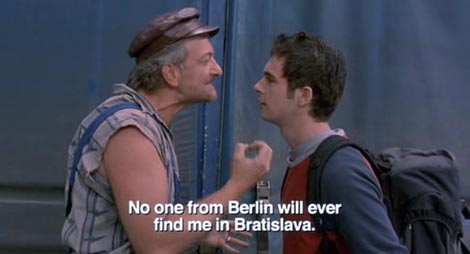
I was meant to have typed up a post on Dubai by now, but I unfortunately haven’t been able to find the time… Prague is a pretty city, and although it’s regarded as being in Eastern Europe, it’s very much like a Western European country. Tomorrow Dorian and I leave for a place where no one in Berlin will find us … BRATISLAVA!
So there I am, speeding down Sheikh Zayed road in Sanjay’s new Mercedes SLK350, watching 5-star hotels, which cost more per night than I will make in a month, go by. (I only met Sanjay a couple hours before that, but that’s another story.) The outside temperature gauge on the car has just hit 50*C and I’m glad that virtually everywhere here is airconditioned… Dubai is such a complete change in tone to this trip, and it’s really quite a remarkable place. The full story later.
| 142 days spent in current location | |
| Previously | Copenhagen, Denmark |
| » Currently | San Francisco, CA (30/12/25 7:21am) |
| View full itinerary... | |


 1:26am (GMT -8.00) from San Francisco, USA