I think I need a t-shirt that reads, “I’m not Japanese or Korean” in as many languages as possible.
While walking through the Spice Bazaar (encumbered with several kilos of lokum), every 30 seconds a shopkeeper would intercept me with a konichiwa, ohayo followed by a stream of unintelligible gibberish which I can only assume is Japanese (or its Korean equivalents). This now familiar scenario plays out thusly:
“I don’t understand. I’m not Japanese.”
“Oh. Where you from?”
“Australia.”
Pause. “Ow-stra-lee-a?”
“Yes.”
“Originally, where you from?”
“Australia.”
“Ow-stra-lee-a?!” will come the reply, a little more emphatic in its bewilderment. “No… originally? You understand this word, ‘originally’?”
“Yes, I was born there.”
This is not the answer they expect and more often than not I walk away at that point, leaving them speechless in what is either a state of confusion or disbelief or both.
Tonight at the fish markets we were confronted by another tout. After trying the Japanese and Korean greetings, he finally settled on Ni hao. We kept saying hello, but that only made him cycle back to the Japanese and Korean greetings. Despite the fact that neither I nor my parents are native Mandarin speakers (in fact, mum is the only one that speaks it), we resigned to being pigeonholed as mainlanders. Which led to quite a peculiar one-sided conversation.
“Ah, China! I am from [unintelligible].”
“Where?”
“[Unintelligible]. You know Caucus?”
“What?”
“Caucus. You know Azerbaijan…”
“Oh, Caucausus!”
“Yes, I from [unintelligible]… er… Georgia.”
“Oh, Georgia!”
“I like China. Mao Tse Tung, Chiang Kai-Shek, Sun Yat Sen, yes? I study back in Georgia. I like Mao Tse Tung, he is good man. When Soviet Union not socialist anymore, China don’t want to have anything to do with that so I like him.”
“Uh…”
Hence, the t-shirt idea (if you can translate the sentence into another language, please leave a comment!)
As far as cities go, Istanbul is a little more distinctive than most. It is unique in that it straddles two continents – Europe and Asia, separated by the Bosphorus. It is one of the world’s handful of megacities, with a population somewhere around 15 million. It also has a varied past stretching over two and a half millennia. Originally named Byzantium by its founder Byzas, it eventually became the eastern capital of the Roman empire and after the death of Emperor Constantine, was renamed to Constantinople. Constantine was baptised a Christian on his deathbed, and during the same period Christianity had planted its roots in that region of the world. Constantinople fell to the Ottomans in the 15th Century and the city was ultimately renamed Istanbul (though the Greeks today still persist in calling it Constantinople). Throughout the years, the Christian demographic of the city changed to become predominantly Muslim. The Republic of Turkey was founded in 1923 by Ataturk who converted Turkey into a secular state, despite being a Muslim himself.
One of Istanbul’s most famous monuments, Ayasofya (Hagia Sofia or Sancta Sofia in Greek and Latin respectively), mirrors the change in control of Istanbul over the years. It was originally a church. When Constantinople was conquered by the Ottomans, they couldn’t bring themselves to destroy the church, so they just plastered over its Christian artworks and coverted the building into a mosque. When Ataturk founded the Republic, he converted the mosque into the museum it is today. Restoration works have seen the original Christian art adorn the walls once again, and it is strange seeing the mix of Christian and Islamic art/symbols on the same structure.
Despite its population being overwhelmingly Muslim (ubiquitous mosques, the azan periodically sounding throughout the streets, the absence of pork from any menus, etc – though alcoholic raki seems to be readily available), Turkey interestingly prohibits by law the wearing of religious headwear and other “theo-political symbolic garments” for both genders in government buildings, schools, and universities. This parallels similar developments in Western European countries.
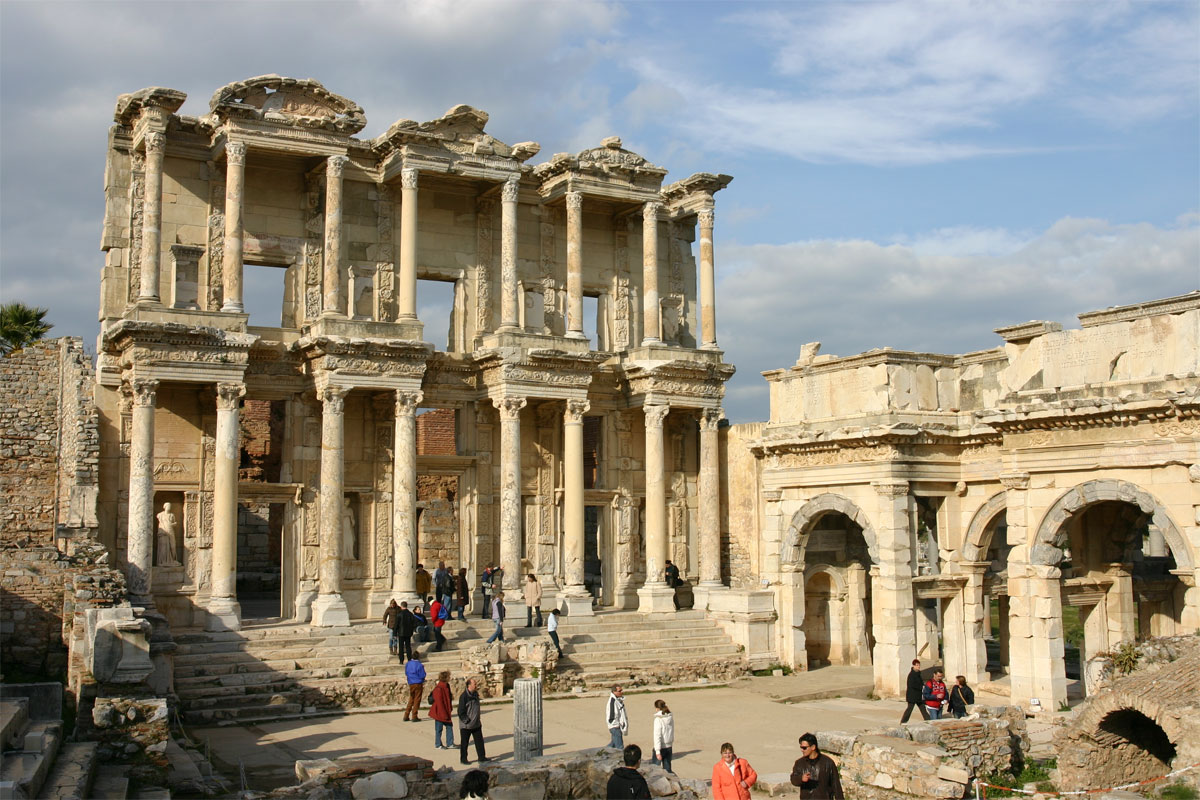
We took a daytrip to Ephesus, sold to us by our guide as the “largest excavation site on Earth”. Formerly a huge Roman city of 300,000, its harbour silted up over the years, turning the port into a muddy marshland. This attracted Malaria-carrying mosquitos and forced the residents of Ephesus to retreat to what is now the modern day town of Selçuk. Meanwhile, the shoreline retreated 8 kilometres out and left Ephesus high, dry, and deserted. Ephesus was never resettled, and so unlike other sites of ancient cities (Rome, Athens, etc), there was nothing above the city ruins except dirt. Ephesus is well worth the visit and it is surprisingly easy to imagine how it was a bustling and cosmopolitan city a couple millennia ago. The façade of the Library at Ephesus is world-famous, but more interesting to me was the fact that it was built directly opposite a brothel (perhaps seen as more socially acceptable given that the patron deity of Ephesus was Artemis, goddess of fertility?) Some enterprising men built an underground tunnel connecting the library with the brothel, so a man could use the justification of visiting the library as a convenient cover story for a quick “tribute to Artemis” along the way (the library was only open to men, so it wasn’t as if women could check up on their husbands).

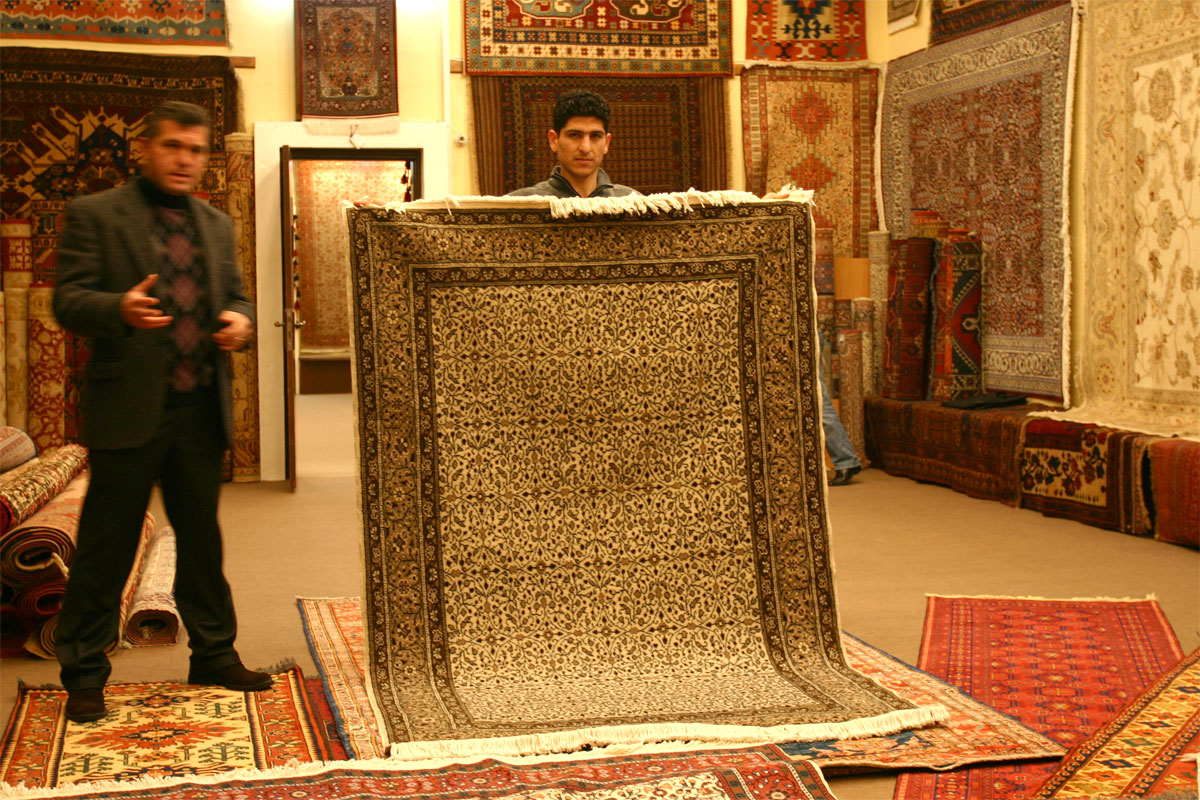
Carpet sales

Library of Celsus
Paul passed through Ephesus on his evangelical travels and Paul’s Epistle to the Ephesians is attributed as having been addressed to the Christians in Ephesus. John and Mary (Jesus’ mother) are also considered to have settled in Ephesus, and the house of the Virgin Mary is a popular site for visiting Catholics and Muslims alike. The setup of the house seemed somewhat tacky and idolatrous to me. (For instance, there’s a wishing board there where people write their wishes to Mary on napkins, tissues and the like and tie them to the board. Slightly less reverential, there’s also a tree stump next to the wishing board on which people have been sticking their wads of chewing gum for years.)
One more day here, then it’s off to Dubai on Sunday.


 (0)
(0) 11:17pm (GMT +11.00)